

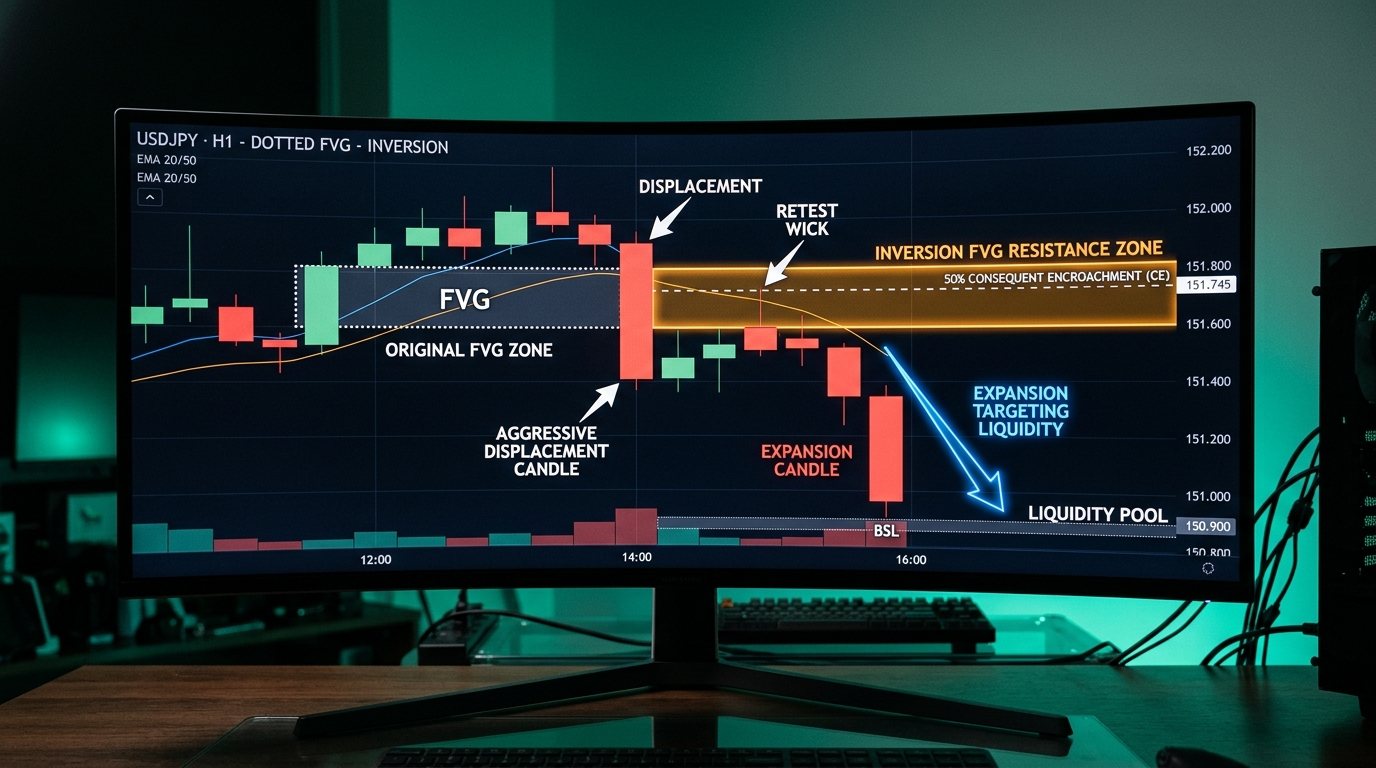
Un Inversion Fair Value Gap (IFVG) ocurre cuando un desequilibrio de 3 velas es perforado con desplazamiento y una vela cierra completamente al otro lado. El soporte se invierte en resistencia y viceversa. Los operadores buscan entradas en el retesteo del Consequent Encroachment (50% de la zona).
- 1. Standard FVG vs Inversion FVG: The Architectural Shift
- 2. The Institutional Trap: Why Broken Imbalances Offer Huge Edge
- 3. The 50% Consequent Encroachment (CE) Precision Rule
- 4. Validation Rules: Candlestick Body Closure vs Wicks
- 5. Step-by-Step IFVG Execution Playbook
- 6. TradingView Pine Script v5 Indicator Code
- 7. Setup Comparison: Inversion FVG vs Breaker Block vs Standard FVG
- 8. Live Chart Case Studies: EUR/USD & BTC/USD Walkthroughs
- 9. Risk Governance & Prop Firm Drawdown Management
- 10. Frequently Asked Questions (PAA)
1. Standard FVG vs Inversion FVG: The Architectural Shift
In classical Smart Money Concepts, a standard Fair Value Gap (FVG) represents a single-sided inefficiency in price delivery. When a high-momentum candle expands aggressively, it leaves a spatial gap between the wick of Candle 1 and the wick of Candle 3. Institutional algorithms routinely guide price back into this 3-candle imbalance to rebalance order books before continuing in the original trend direction.
However, markets do not always rebalance and respect these levels. When underlying institutional order flow shifts—often after a major liquidity sweep or high-impact macroeconomic news release—price does not bounce from the FVG. Instead, it drives forcefully straight through the imbalance like a hot knife through butter.
This event creates the Inversion Fair Value Gap (IFVG):
- Bearish Inversion FVG: An original bullish FVG (which previously offered buy-side support) is breached downwards by a strong red displacement candle that closes completely below the lower boundary. The broken support zone now inverts into a hardened resistance ceiling.
- Bullish Inversion FVG: An original bearish FVG (which previously served as sell-side resistance) is punched through upward by an expansive green candle that closes above the upper boundary. The broken resistance zone now inverts into a structural launchpad of support.
Bearish FVG Violated Upward + Candle Close Above Gap High = Bullish Inversion FVG (Support)
Recognizing this inversion transforms how you view failed trades. When a retail trader gets stopped out because their support level broke, an institutional trader immediately flips their bias, preparing to short the retest of that exact same level as an Inversion FVG.
2. The Institutional Trap: Why Broken Imbalances Offer Huge Edge
Why are Inversion Fair Value Gaps so reliable? The answer lies in the mechanics of trapped retail orders.
When a bullish FVG forms on an intraday chart (such as the 5-minute or 15-minute timeframe), retail algorithm traders and counter-trend participants place limit buy orders inside the zone with stop-loss orders positioned just below the gap boundary.
If commercial interbank algorithms decide to reverse the market, they intentionally drive price through the gap. This triggers two immediate market events:
- Retail Stops Are Liquidated: The resting sell-stops of long traders are triggered, releasing a flood of sell orders that institutional dealers use to build heavy short inventory.
- Trapped Traders Are Frozen: Traders who refused to honor their stop losses find themselves holding underwater positions. When price rallies back up to retest the broken FVG zone, these trapped traders desperately close their positions at break-even (selling to exit longs).
The combination of institutional short selling and trapped retail liquidation turns the inverted FVG into an impenetrable barrier. Price taps the zone and experiences explosive rejection in the direction of the new displacement.
3. The 50% Consequent Encroachment (CE) Precision Rule
In ICT methodology, every price imbalance has a core mathematical equilibrium point known as Consequent Encroachment (CE). For any Fair Value Gap or Inversion FVG, Consequent Encroachment is the exact 50% midpoint between the upper boundary and the lower boundary:
The CE level is the single most critical reference line inside an Inversion FVG:
- High-Probability Retest Level: On healthy Inversion FVG retests, price will frequently wick into the Consequent Encroachment line with surgical accuracy, leaving wicks on the 5-minute candle while the candle body remains outside or in the shallow half of the gap.
- Invalidation Warning: If a candle body closes past the Consequent Encroachment line on the retest, the setup quality deteriorates significantly. If a full candle body closes completely beyond the opposite boundary of the IFVG, the entire setup is invalidated.
When planning orders, professional desks place limit orders at the CE line with a stop loss positioned safely beyond the far boundary of the gap. This tight, systematic structure produces exceptional Risk-to-Reward profiles ranging from 1:3.0 to 1:5.5.
4. Validation Rules: Candlestick Body Closure vs Wicks
Not every candle that pokes through a Fair Value Gap qualifies as an authentic Inversion FVG. At our proprietary trading desk, we enforce the Candle Body Closure Rule to eliminate false signals:
The Body Closure Inversion Mandate
A wick penetrating through an FVG does not invert the gap. The gap only becomes an Inversion FVG when a candle prints a full body close completely through and outside the boundary of the original imbalance.
Examine the distinction carefully:
- Invalid Inversion (Wick Rejection): Price dips through a bullish FVG, tags a lower liquidity pool, but snaps back upward, with the candle body closing inside the original FVG. This is an algorithmic liquidity sweep of the FVG low, not an inversion. Shorting this wick will result in an immediate stop-out.
- Valid Inversion (Displacement Close): An expansive candle with high volume drives through the bullish FVG and closes its real body entirely below the bottom wick of Candle 1. This signals definitive institutional commitment and confirms the zone is now a bearish Inversion FVG.
Opere configuraciones IFVG con precisión profesional. Calcule su riesgo exacto en dólares y lotaje antes de entrar:
Abrir Calculadora de Posición Gratis →5. Step-by-Step IFVG Execution Playbook
To trade Inversion Fair Value Gaps systematically, implement this five-step algorithmic execution checklist:
| Phase | Market Action | Institutional Interpretation | Trader Protocol |
|---|---|---|---|
| Step 1 | Liquidity Purge | Price sweeps major session high/low or key PD Array. | Confirm that liquidity has been harvested on the higher timeframe. |
| Step 2 | Displacement Through FVG | Price violates an existing opposing FVG with aggressive displacement. | Wait for candle body to close completely beyond the gap boundary. |
| Step 3 | Mark Inversion Zone | Convert original FVG to IFVG; calculate Consequent Encroachment (50%). | Highlight the zone and set alert at the near boundary and CE line. |
| Step 4 | Order Placement | Price retraces into the IFVG during an active Killzone session. | Enter limit order at CE (50%) or on first touch; stop placed 2–4 pips beyond far edge. |
| Step 5 | Target Execution | Price expands toward the Draw on Liquidity (DOL). | Take partials at internal liquidity; exit runner at key external swing pool. |
Stop loss placement is non-negotiable:
- Bearish IFVG Stop Loss: Place your stop loss 2 to 4 pips (or ticks on futures) above the top boundary of the inverted gap. If price closes above this level, the thesis is wrong and you exit with minimal capital loss.
- Bullish IFVG Stop Loss: Place your stop loss 2 to 4 pips below the bottom boundary of the inverted gap.
6. TradingView Pine Script v5 Indicator Code
To help you spot and backtest Inversion Fair Value Gaps without manual charting errors, our engineering desk at aFolks Digital designed this open-source Pine Script v5 indicator. It automatically identifies 3-candle FVGs, detects when a subsequent candle body closes through the gap, and repaints the box in amber to signal an active Inversion FVG zone:
Simply copy this code into your TradingView Pine Editor. Once added, broken FVGs will immediately transform into solid amber or cyan Inversion FVG zones, providing clear structural clarity during live market sessions.
7. Setup Comparison: Inversion FVG vs Breaker Block vs Standard FVG
Traders frequently confuse Inversion FVGs with Breaker Blocks and Standard FVGs. The comparison table below highlights their architectural and execution differences:
| Execution Model | Underlying Price Element | Trigger Mechanism | Polarity Shift | Confluence Ranking |
|---|---|---|---|---|
| Standard FVG | Single-sided 3-candle imbalance | Price rebalances inefficiency in trend direction | None (Original bias holds) | Core Baseline (★★★☆☆) |
| Inversion FVG (IFVG) | Failed 3-candle imbalance | Price closes completely through gap, then retests | Support flips to Resistance / Vice Versa | High Conviction (★★★★☆) |
| The Breaker Block | Failed Order Block after liquidity sweep | Price violates swing block that caused liquidity run | Order Block flips to Breaker | Institutional Grade (★★★★☆) |
| The Unicorn Setup | Breaker Block + Inversion FVG | Breaker Block overlaps directly inside Inversion FVG | Dual Structural Flip | Elite Tier Setup (★★★★★) |
When an Inversion FVG overlaps with a Breaker Block at the exact same price coordinates, you have the institutional Unicorn Setup. For a full walkthrough on trading this dual-confluence powerhouse, review our dedicated guide in The Unicorn Setup Strategy: Breaker Blocks & FVG Confluence.
8. Live Chart Case Studies: EUR/USD & BTC/USD Walkthroughs
Case Study 1: EUR/USD London Session Inversion Short
- Market Setup: During the Asian session, EUR/USD pushed upward, printing a 12-pip bullish FVG between 1.08720 and 1.08840.
- The Breakout: At 03:00 EST (London Open), price swept the Asian High liquidity at 1.08950, as examined in our Asian Range Liquidity Sweep Guide.
- The Inversion: A massive red 15-minute displacement candle plunged from 1.08980 down to 1.08640, closing decisively below the 1.08720 bottom wick of the bullish FVG. The zone instantly inverted into a bearish IFVG.
- The Execution: Sophia Sterling set a limit sell order at Consequent Encroachment (1.08780). Stop loss was set at 1.08880 (10 pips risk).
- The Result: At 03:45 EST, a pullback wicked into 1.08785, filling the order before plunging 42 pips into the New York session toward the Asian Low, yielding a swift +1:4.2 R:R return.
Case Study 2: Bitcoin (BTC/USD) 15-Minute Bullish Inversion
- Market Setup: BTC experienced an aggressive downward dump during Asian hours, leaving behind a 15-minute bearish FVG between $64,200 and $64,650.
- The Inversion: Upon sweeping sell-side liquidity at $63,800, buyers entered with heavy spot volume. A series of three consecutive green candles blasted through the $64,650 level, closing a 15-minute body at $65,100.
- The Retest: BTC drifted downward into the inverted resistance zone, touching the CE level at $64,425 with an exhaustion wick.
- The Trade: Long entered at $64,450, stop loss at $64,150 ($300 risk), target at previous daily equal highs of $65,800 ($1,350 reward). The trade closed in profit for a clean +1:4.5 R:R winner.
9. Risk Governance & Prop Firm Drawdown Management
Inversion FVGs provide precise entries, but they require strict capital discipline. If you trade with funded accounts at firms like FTMO, Topstep, or Apex Trader Funding:
- Maintain Constant 1% Unit Risk: Calculate your lot sizing using our free risk calculator so that an invalidation stop-loss costs exactly 0.5% to 1.0% of your account balance.
- Protect Against Daily Loss Limits: Never double your lot size after a loss hoping for an IFVG revenge trade. Adhere to the risk protocols detailed in Prop Firm Risk Management.
- Monitor Trailing Drawdown Constraints: Review Trailing Drawdown vs Static Drawdown to ensure trailing equity floors do not close your position prematurely.
- Respect Payout Consistency Caps: If your IFVG trade produces a windfall profit day, verify your single-day profit cap ratio using our comprehensive guide in Prop Firm Consistency Rule Calculation.
To explore our institutional mentorship courses and interactive trading software, visit the aFolks Learning Platform and access professional analytics tools at aFolks Tools.