
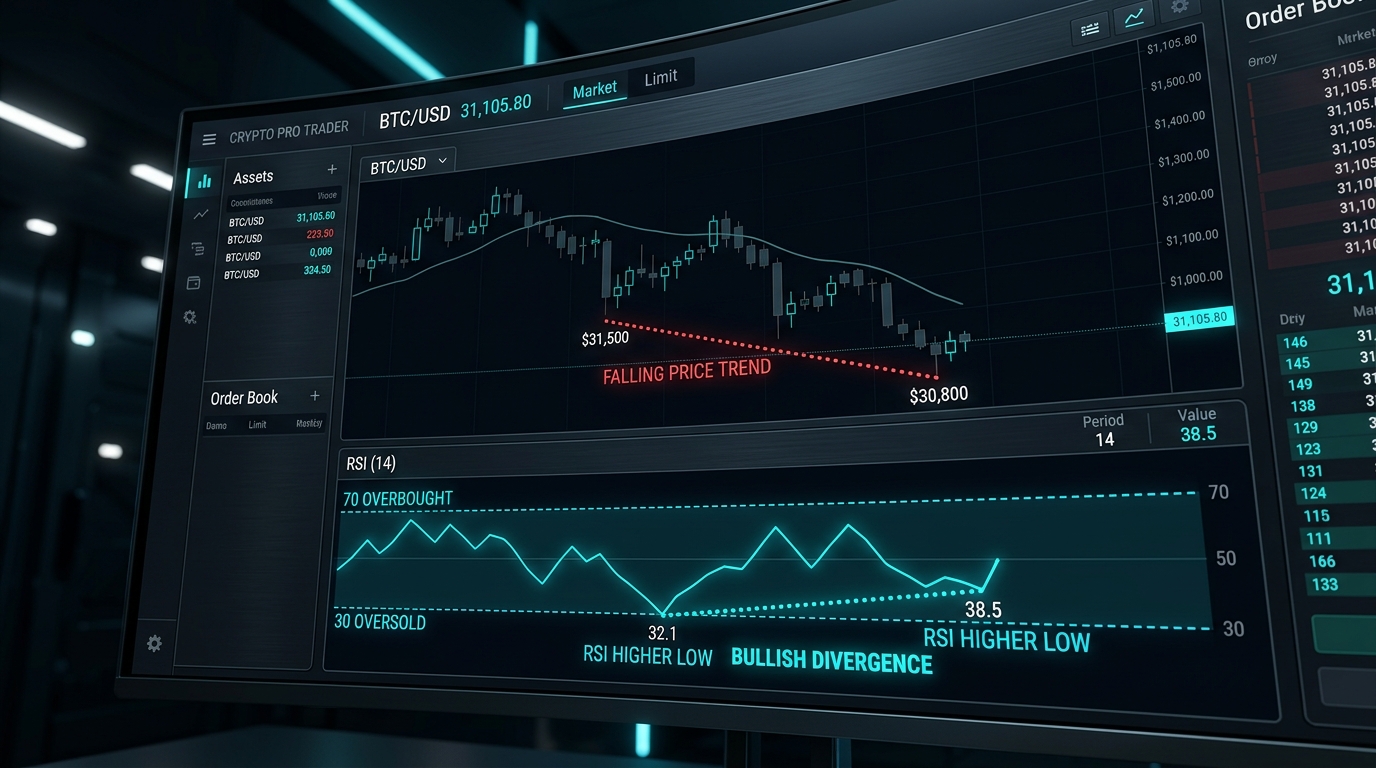
Understanding the 14-period RSI momentum oscillator
Developed by J. Welles Wilder, the Relative Strength Index (RSI) measures the velocity and magnitude of directional price moves on a scale from 0 to 100. Standard settings place overbought levels at 70 and oversold levels at 30.
Trading RSI divergences for trend reversals
RSI divergence occurs when price action makes a higher high, but the RSI oscillator makes a lower high (Bearish Divergence). Conversely, when price makes a lower low while RSI makes a higher low (Bullish Divergence), a powerful trend reversal is often imminent.
RSI trading rules for high win-rate entries
- Never sell simply because RSI touches 70 in a strong uptrend; wait for a confirmed divergence or market structure shift.
- Use the 50 centerline level: RSI staying above 50 confirms bullish control, while staying below 50 indicates bearish control.
- Combine RSI bullish divergence at a key higher timeframe Order Block for maximum confluence.
Avoid buying oversold conditions in strong downtrends
During aggressive market liquidations, RSI can stay below 30 for extended periods. Buying solely because RSI is oversold without price structure confirmation leads to severe drawdowns.
Where Afolks Digital Fits
Afolks Digital provides precision position-sizing tools, automated trade signal broadcasts, and risk management calculators for retail Forex, Stock & Crypto traders. It supports disciplined risk management by calculating exact lot sizes before executing trades live.
Frequently Asked Questions
What is RSI divergence?
RSI divergence occurs when price action and the RSI oscillator move in opposite directions, signaling weakening momentum and potential trend reversal.
What is the best setting for RSI?
The default 14-period setting is standard across technical analysis and delivers reliable signals across Forex, Crypto, and Stock markets.
Can RSI be used for day trading?
Yes! Day traders use RSI on 5-minute and 15-minute charts to spot momentum exhaustion and divergence at daily support/resistance levels.